Turn Your Food Photos Into Tiny Miniature Replicas With AI
Miniature food is one of those internet obsessions that never really dies — tiny ramen bowls, palm-sized breakfast spreads, dollhouse bakeries. What’s new is that you no longer need polymer clay and a steady hand. One prompt turns a photo of the actual meal in front of you into a tiny, hand-crafted-looking replica.
We tested this with a bowl of miso ramen. The result kept every ingredient — the corn, the butter pat, the soft-boiled egg, even the black spoon — faithfully shrunk onto a little wooden display base.
The Tested Prompt
Take a photo of your dish from a slight angle (the way you’d photograph it for a menu), then use:
Turn this dish into a miniature hyper-detailed replica of exactly this bowl,
displayed on a plain small wooden base. No nameplate, no text, no labels or
lettering anywhere in the image. Studio product photography, soft warm lighting,
shallow depth of field. Keep the ingredients and plating exactly as in the photo.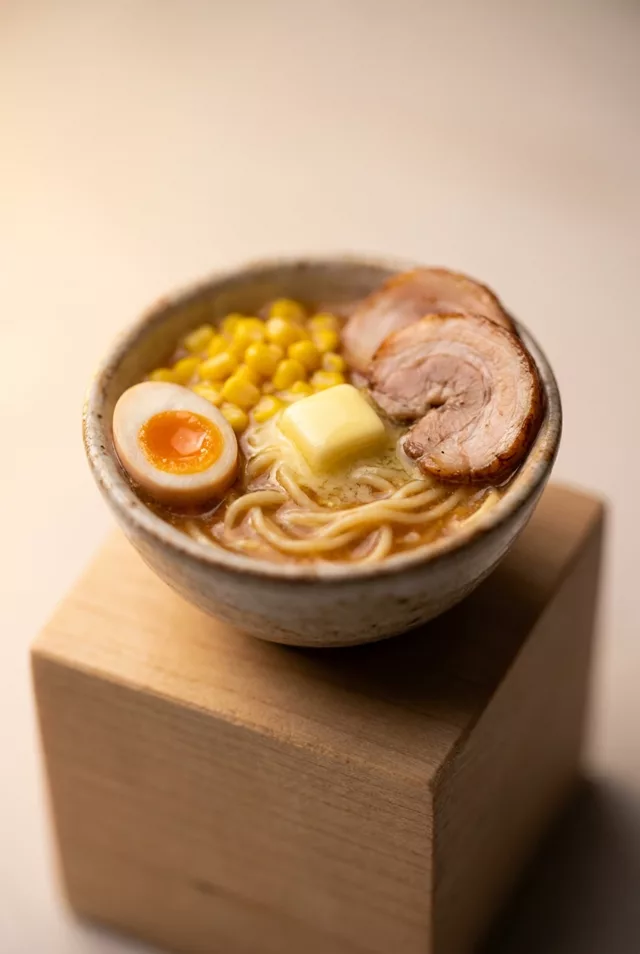
Works in Gemini, ChatGPT or any AI image editor that accepts a photo. Two phrases in there do the heavy lifting:
- “exactly this bowl” / “exactly as in the photo” — without these anchors the model swaps your meal for a generic version of the dish.
- “No nameplate, no text…” — miniature and collectible styles love to add little brass plaques with invented gibberish. Ban them up front. (We wrote a whole guide on this: how to stop AI images adding unwanted text.)
Why Food Works So Well
Photo transforms of people fight one hard problem: keeping the face recognizable. Food has no face. That makes this one of the most reliable transforms you can run — no identity drift, no awkward hands, just texture and lighting. It’s a great first prompt to try if you’re new to AI photo editing.
It also solves the “I have nothing to post” problem: everyone photographs food anyway, and the miniature version of your everyday lunch is instantly more shareable than the original photo.
What Goes Wrong
It just reads as a normal bowl. Our ramen result works because of exactly two things: a plain wooden block under it, and a depth of field so shallow that the far rim of the bowl is already soft. Both are cues you only see in macro shots of small objects. Drop either one — no base, or a deep-focus “on a dining table” framing — and you’ve made a very nice photo of dinner.
Your table disappears. “Studio product photography” doesn’t just relight the scene, it replaces your whole environment with a seamless backdrop. Usually that’s the point. If the café table was part of the story, drop the studio wording and add “keep the original background and table surface, just make the dish tiny.”
Variations Worth Trying
- Bakery shelf: “…displayed on a tiny wooden bakery shelf among miniature bread baskets” for pastries and desserts.
- Full table: the whole spread shrunk onto one base — full prompt below.
- Seasonal gift look: “…inside a small clear display dome” turns holiday dishes into snow-globe-style keepsakes.
Keep the no-text clause in all of them.
The Whole-Table Version
The single-bowl prompt is the reliable one. The whole-table version is the one people stop scrolling for — a birthday spread or a holiday dinner on one base instead of five separate photos:
Turn this whole meal into a miniature hyper-detailed diorama of exactly this
table, every dish shrunk together onto one small round wooden base. No nameplate,
no text, no labels or lettering anywhere in the image. Studio product photography,
soft warm lighting, shallow depth of field, the base small enough to sit in one
palm. Keep every dish, ingredient and the plating arrangement exactly as in the
photo.
Shoot it from the same 30–45 degree angle, and take the photo before anyone starts eating — the model shrinks what it sees, including the empty plates.
Bring It to Life
The miniature photo is step one. Feed the result to an image-to-video model (Kling, Veo or similar) with an orbit prompt — the camera slowly circling the tiny dish while it sits perfectly still reads as a real product video of a real miniature. We keep a tested version in the library as Figurine Orbit Showcase, and it works unchanged for food replicas.
Build your own variation in the prompt generator or grab the ready-made version from the prompt library.
FAQ
My miniature looks like a normal-sized bowl. What went wrong? Scale cues come from the base and depth of field. Keep “small wooden base” and “shallow depth of field” in the prompt, and avoid wide framing words like “on a dining table.”
Can I do drinks too? Yes — lattes and cocktails work especially well because of the glassware. Swap “dish” and “bowl” for “drink” and “glass” in the prompt.
Does it matter what angle I photograph from? A 30–45 degree angle (standard food-photo angle) gives the model the most information about the plating. Straight-down shots flatten the miniature.